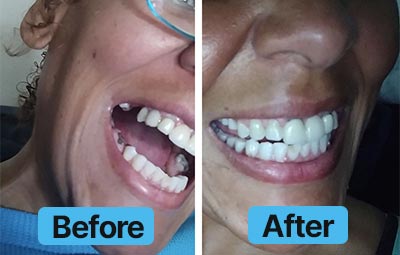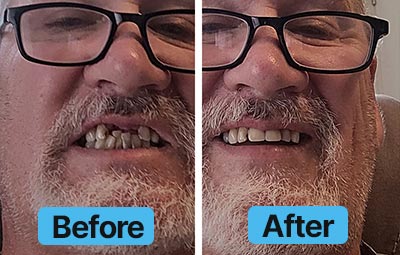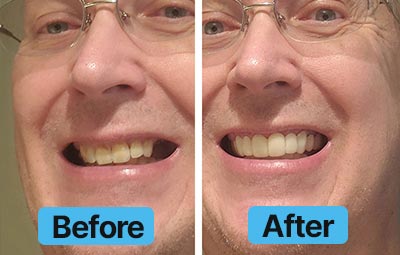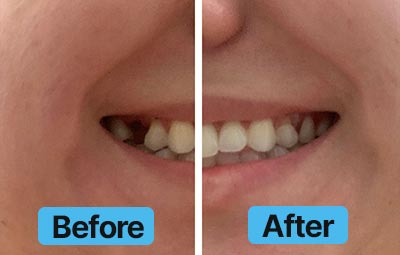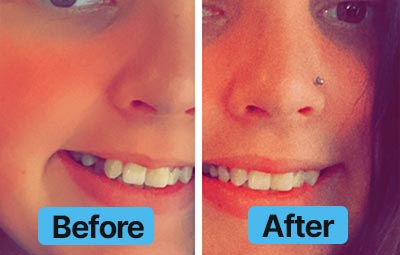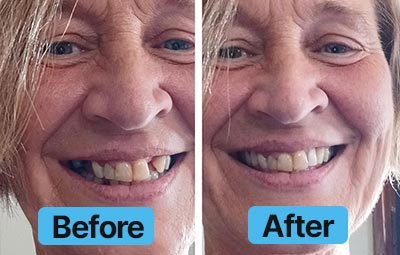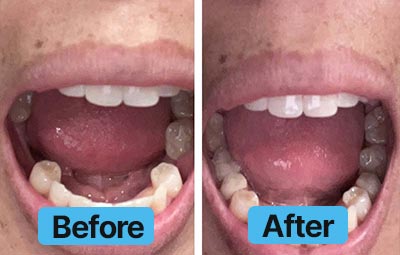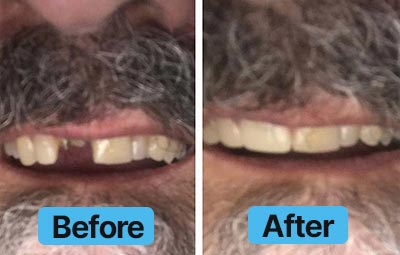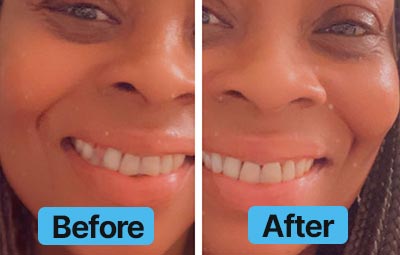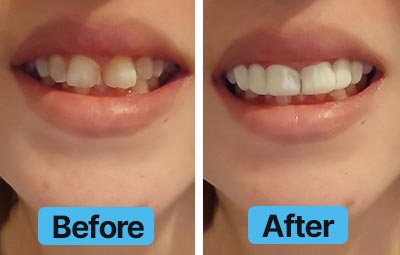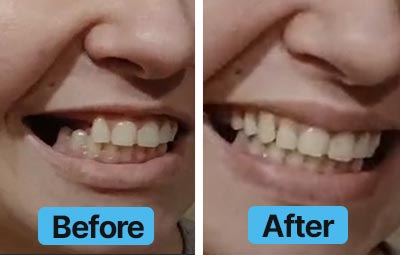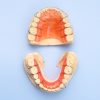
Replacing one missing tooth with a bridge costs $2,000 to $5,000 at a dental office, because a bridge is three units of work: a false tooth plus a crown on each neighbouring tooth. A partial denture replaces the same tooth from $399 direct from our lab, with nothing drilled and nothing filed. Below: what each one actually is, what drives the price, and how to tell which fits your mouth.
Going about your life with a missing tooth can definitely disrupt how you talk, how you eat, and the confidence you have in yourself. And this problem is magnified if you’re missing multiple teeth.
Luckily, you have two options that can help you restore your smile by replacing those missing teeth: partial dentures vs bridges.
- Dentures are removable and much cheaper.
- Bridges are permanent.
But cost and convenience are just part of the equation—you’ve got to think about comfort, durability, and how each fits your lifestyle.
So, which one’s right for you? Keep reading, and by the end, you’ll have a clear picture of what makes the most sense for your mouth (and your wallet).
What Are Partial Dentures vs Bridges?
Both do the same basic job. They fill the space a missing tooth leaves behind so the teeth around it stop drifting, and so you can chew and speak normally again. Both are custom-made in a dental lab from an impression of your mouth, and both are built around a false tooth shaped and coloured to match the ones either side of it. The difference is everything else: whether it comes out, what it costs, and what it does to the teeth next door.
What Are Partial Dentures?
Partial dentures are removable appliances designed to replace one or more missing teeth.
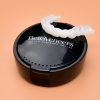
They typically consist of prosthetic replacement (fake) teeth attached to a gum-colored base that blends with your natural gums. Sometimes, they are invisible due to the clear thermoplastic materials used, like the Essix Partial Denture Retainer.
Depending on your needs, partial dentures come in a few options: acrylic, metal, and flexible.
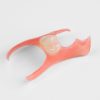
Acrylic partial dentures (often called “dental flippers”) are lightweight and extremely convenient. They’re usually used as temporary solutions (but they do last up to 3 years). It’s recommended that you remove them before eating, but you can technically eat soft foods with them.
Metal partials are stronger and last longer (and they’re more expensive). They can also be slightly more uncomfortable for some.
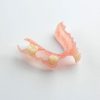
Flexible partial dentures give you the comfort of acrylic dentures with the sturdiness of metal partials. These are extremely comfortable, last up to 8 years, and are great for those sensitive to metal or acrylic materials. Plus, you can eat or drink just about anything while wearing them. They’re a bestselling appliance for a reason!
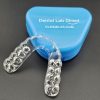
Only have one or two missing teeth? Skip the flexible partial denture and get yourself a Nesbit Flexible Partial Denture. This appliance rests on one side of your mouth and is easy to get used to since it securely snaps into place.
Discreet, professional, and comfortable, these appliances will immediately boost your confidence!
What Are Bridges?
A dental bridge is a fixed appliance that fills a gap by anchoring to the teeth on either side of it. The false tooth in the middle is called a pontic; the teeth holding it up are called abutments.
There are three common types:
Traditional bridge: a crown on each abutment tooth with the pontic fused between them. This is the standard, and it is what most people mean when they say “a bridge.”
Cantilever bridge: a crown on one side only, with the pontic extending out over the gap. Used when there is a natural tooth on just one side. It is not as strong as a traditional bridge.
Maryland bridge: instead of crowns, metal wings are bonded to the backs of the neighbouring teeth. Mostly used for front teeth, because it cannot take the chewing force at the back of the mouth.
One detail worth knowing before you agree to it: to fit a traditional or cantilever bridge, the dentist reshapes the two anchor teeth by removing enamel, and that step is irreversible. Those teeth carry a crown for the rest of their life, whether or not there was anything wrong with them to begin with.
Once a bridge is cemented, it stays in. You clean it in your mouth, not out of it.
Key Differences Between Partial Dentures and Bridges
| Partial denture | Dental bridge | |
|---|---|---|
| Stays in your mouth? | Removable, take it out any time | Cemented in place; only a dentist removes it |
| Cost to replace one tooth | From $399 direct from our lab | $2,000 to $5,000 at a dental office [2] |
| Effect on the teeth either side | None, nothing is touched | Both filed down for crowns, permanently [1] |
| Typical lifespan | 3 to 8 years | 5 to 15 years [1] |
| Gaps that aren’t side by side | Handles them | Cannot, teeth must be consecutive |
| Cleaning | Take it out and brush it | Brush in place; floss under the pontic with a threader |
| Adjusting or replacing it | Straightforward | A new procedure |
1. Removable vs. Fixed
The biggest difference between partial dentures vs bridges is whether they can be removed.
Partial dentures are removable, which means you can take them out whenever you like—for cleaning, sleeping, eating, or just to give your mouth a break.
Lots of people love this aspect of partial dentures. And who wouldn’t? It gives you control over your mouth with the added bonus of not having to do an expensive procedure.
This also adds a layer of convenience for many people, as maintaining them is as simple as taking them out and brushing them.
In contrast, bridges are fixed appliances. Once they’re in, they stay in.
While this means you don’t have to worry about losing or misplacing them, it does require more commitment (namely cleaning).
Cleaning is much easier to do with a partial denture (just take it out of your mouth and brush it, then let it soak overnight). With bridges, you can brush it like regular teeth (which is great), but flossing underneath the bridge can be a bit tricky (not as great).
So, if you prefer something low-maintenance and temporary, partial dentures are the best option out of the two.
2. Cost Comparison
Depending on the material and type, partial dentures can cost anywhere from a few hundred to a couple thousand dollars.
A major benefit that is often overlooked is that if you need to adjust or replace them (which usually won’t be for around 3-8 years), it’s not a huge hassle.
Bridges, on the other hand, come with a higher upfront cost. They typically range from $1,500 to $5,000 depending on type: a Maryland bridge sits at the low end, while a traditional or cantilever bridge runs $2,000 to $5,000 for one pontic plus a crown on each abutment tooth.
While this can be more of an investment, the appeal is in their permanence—you pay for the long-lasting stability they provide.
Unless, of course, you need to adjust or replace them. Keep in mind that dental bridges typically last 5-15 years.
If price is a major concern, the more affordable option is usually partial dentures vs bridges.
Where a partial lands in that range depends on the type:
| Partial denture type | Best for | Direct from our lab | Typical dental office [3] |
|---|---|---|---|
| Clear retainer (Essix) partial | Temporary, discreet front-tooth replacement | from $299 | — |
| Nesbit (unilateral) partial | 1 to 2 teeth on one side | from $399 | — |
| Acrylic partial (flipper) | Affordable multi-tooth replacement | from $449 | $1,000 to $1,800 |
| Flexible partial | Natural look, no metal clasps | from $549 | $1,100 to $1,700 |
| Cast metal partial | Maximum durability, metal framework | Not made by our lab | $2,000 to $2,500 |
Our partial dentures cost guide breaks down what drives each of those prices.
3. Durability and Longevity
Partial dentures tend to last between 3-8 years with proper maintenance. That’s a long time for a solution that can be adjusted as your needs change.
Bridges, while a more permanent solution, typically last 5-15 years, and good habits plus regular checkups push them toward the upper end of that range.
However, because they are permanently affixed to surrounding teeth, bridges can put extra pressure on those teeth, leading to potential issues down the road. Eventually, they may need to be replaced, especially if the supporting teeth start to weaken.
Because of this, if you have sensitive teeth or are more prone to decay or fractures, you may be at risk for tooth loss.
4. Location of Missing Teeth
Partial dentures can replace one or more teeth anywhere along the arch.
A bridge can only fill in consecutive missing teeth, meaning the teeth to be replaced must be side by side.
This makes partials a more versatile option for non-adjacent tooth loss.
Partial Denture vs Bridge Cost: What You’re Actually Paying For
A “3-unit bridge” sounds like one appliance. It is three: the false tooth, plus a crown for each of the two teeth holding it up.
That is why the price lands where it does. Healthline puts a traditional or cantilever bridge at $2,000 to $5,000 for one pontic and a crown on each abutment tooth, and prices a single crown on its own at $500 to $2,500 per tooth. Run those numbers and the two crowns account for most of the bill — and those two teeth were not the reason you came in.
There is a second cost that never appears on the invoice. Both anchor teeth have to be filed down to take a crown, and Cleveland Clinic is explicit that removing that enamel is irreversible. If the bridge fails in twelve years, those teeth do not go back to being ordinary teeth. They need another crown, or another bridge.
A partial denture is one appliance. Nothing is filed, nothing is cemented, and the teeth either side stay exactly as they are. That difference is most of the price gap — and it is the reason the two options are not really comparable on cost alone.
Bridges vs Partial Dentures: Which is Right for You?
When deciding between partial dentures vs bridges, it ultimately comes down to your preferences, budget, and dental needs.
Partial dentures can give you more flexibility and affordability. Bridges are a more permanent fix.
When a bridge is genuinely the better call. We make partials, not bridges, so take this for what it is — but there are cases where a bridge is the right answer:
- The anchor teeth already need crowns: if the teeth either side are heavily filled, cracked, or already crowned, that prep work is happening anyway, so a bridge costs you nothing extra in enamel.
- You cannot tolerate anything removable: some people never adapt to taking an appliance in and out, and a fixed solution you will actually wear beats a removable one you won’t.
- One gap between two healthy teeth, and you want it handled once: a bridge is a bigger commitment up front that you then stop thinking about.
If none of those describe you, a partial does the same job without touching the teeth either side.
Need help deciding? Dental Lab Direct offers expert guidance and affordable at-home kits. So check us out and let us know if you have any questions!

Partial Dentures vs Bridges: Common Questions
How much does a 3-tooth bridge cost without insurance?
$2,000 to $5,000. Worth knowing: “3-tooth bridge” almost always means three units — one false tooth plus two crowns — not three missing teeth. It replaces a single tooth. A partial replacing that same tooth is $399 direct from our lab.
How much is a dental bridge for one tooth with insurance?
It varies by plan, but bridges are classed as major restorative work, which most plans cover at a lower percentage than fillings or cleanings. The bigger constraint is usually the plan’s annual maximum, which often runs out before a bridge is fully paid for. Check your annual maximum and your major-services percentage before you commit.
Are bridges expensive?
Relative to what they replace, yes — $2,000 to $5,000 for one missing tooth, and most of that is the two crowns rather than the false tooth itself. If cost is the deciding factor, a partial replacing the same tooth starts at $399.
Is a bridge better than a partial?
Neither is better in general; they solve the problem differently. A bridge is fixed, lasts 5 to 15 years, and permanently costs the two neighbouring teeth some enamel. A partial is removable, lasts 3 to 8 years, costs far less, and leaves your other teeth untouched. Three questions decide it: are the neighbouring teeth healthy, can you live with something removable, and what is your budget.
Does a bridge stay in your mouth?
Yes. It is cemented to the anchor teeth and only a dentist can remove it. You brush it like natural teeth, but flossing under the pontic needs a threader or a water flosser. A partial comes out whenever you want.
How much do partial dentures cost without insurance?
From $299 to $549 direct from our lab depending on the type, against roughly $1,000 to $2,500 at a dental office. Our licensed dentists are not affiliated with insurance networks, but custom-made appliances are covered by many plans as an out-of-network service, and FSA or HSA funds can usually be used. Our guide to partial dentures walks through each type side by side.
Sources
[1] Cleveland Clinic, Dental Bridges: Types & Who Needs Them — bridge types, pontic/abutment anatomy, irreversible enamel removal, 5-15 year lifespan.
[2] Healthline, Dental Bridge: 4 Types, Benefits, Use Case and Costs — traditional and cantilever bridges $2,000 to $5,000; a single crown $500 to $2,500 per tooth.
[3] Healthline, Partial Dentures: Cost, Types, and How to Choose — dental-office price ranges by partial type. Direct-from-lab prices are our own current product pricing.