Summary Rinse and brush your night guard every morning. That two-minute habit prevents most of the smell and staining people complain about. Deep clean it weekly, not monthly. A weekly soak reaches buildup that a quick brush leaves behind. Safe deep-clean options: a cleaning tablet, diluted white vinegar, or hydrogen peroxide, for 10 to 30 minutes. Never soak longer than an hour, and never every day. A bad smell or a cloudy film is not just normal. It is bacteria or hard-water minerals, and bo...
READ MOREBlog
Partial Dentures Cost: A Lab’s Breakdown of What You Actually Pay For
Summary Partial dentures cost between $300 and $5,000+ per arch depending on material, case complexity, and where you buy. Most people pay $800 to $2,500 through a dentist office. Lab-direct sellers like us start at $299, below the bottom of the typical range, because we cut the office overhead. Three things drive the price: material grade (acrylic, flexible nylon, or cast cobalt-chromium), case complexity (number of teeth, location, arch), and channel (DIY, lab-direct, dentist-fitted)....
READ MOREWhat Are the Best Partial Dentures? A Lab’s 5-Criteria Framework
Summary The best partial dentures aren't a brand. They're a device that meets five measurable quality criteria: material spec, dimensional fit, finish and polish, occlusion calibration, and manufacturing transparency. ISO 20795-1:2013 is the international standard for denture base polymers. It sets exact limits on residual monomer, sorption, solubility, and flexural strength. A partial denture that misses these limits usually shows it within 6 to 12 months of wear. A quality partial ...
READ MOREWhat Are Partial Dentures? Types, Cost & Options
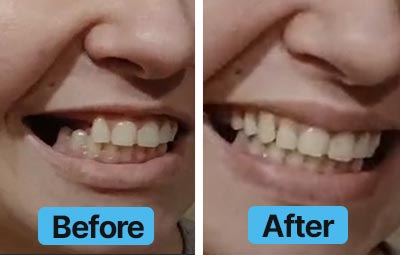
Summary Partial dentures replace some of your missing teeth, not all of them, by clipping onto the natural teeth you still have. The main removable types are flexible, acrylic flipper, single-tooth, and clear Essix, each suited to a different gap and budget. They do real work: restore chewing and speech, and stop your remaining teeth from drifting into the gap. Missing just one tooth? A single tooth denture is a fast, low-cost way to fill it without surgery. Direct-to-you partials run $299 to ...
READ MOREBuying Partial Dentures Online vs In-Person: An Honest Comparison
Summary Buying partial dentures online can save 50 to 70 percent vs in-person, but the savings only translate to a good outcome for the right kind of case. For straightforward replacements (stable mouth, clear impression, no complicating factors), online is often the right move. For complex cases, in-person is genuinely worth the markup. The 'online vs in-person' question is usually framed as a binary by content that benefits from one side winning. The honest framing is case-specific, w...
READ MOREFlexible Partial Dentures: The Complete Guide
Summary Flexible partial dentures are removable, made from thin nylon, and use gum-colored clasps instead of metal, so they look more natural and feel lighter. They are a strong pick if you have a metal allergy, want no visible clasps, or found rigid partials uncomfortable. The main catch: nylon cannot be relined or adjusted, so when your gums change shape, the partial is remade rather than refit. They replace some teeth, not a full arch, and they need enough healthy teeth to clasp onto. DLD f...
READ MOREGetting Used to New Dentures: First-Week Guide
Summary Most people spend about 30 days getting used to new dentures. The first few days are the hardest, then it gets easier fast [3]. Soreness, extra saliva, and a slight lisp in the first week are normal and temporary. Start with soft foods, take small bites, and chew on both sides at once to keep the denture stable. Practice talking out loud. Reading or singing at home speeds up your speech more than waiting does. Clean your dentures daily and take them out about 8 hours a day to rest your...
READ MORERemovable Veneers: Types, Cost & How to Choose
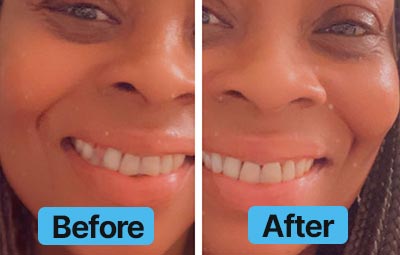
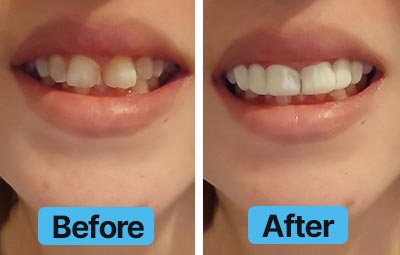
Summary Removable veneers snap over your natural teeth to cover stains, minor chips, and small gaps, with no drilling and no permanent changes. Snap-on, clip-on, and pop-on veneers are all the same thing. The label is marketing, not a real difference. The choice that actually matters is custom (made from an impression of your teeth) versus a one-size, off-the-shelf tray. Removable veneers are a cosmetic cover, not dental treatment. They do not fix cavities, gum disease, bite problems, or repla...
READ MOREOver-the-Counter vs Custom CPAP Alternatives: Are Cheap Options Worth It?
Summary OTC anti-snore mouthpieces are FDA-cleared for snoring, not for diagnosed obstructive sleep apnea (OSA). The regulatory line is real, and treating them as interchangeable wastes money and time. The CPAP-alternative market has three tiers, not two: OTC ($30 to $150), DTC custom with telehealth prescription ($600 to $900 all-in), and dentist-fitted custom ($1,800 to $10,000). All three tiers carry the same FDA Class II classification. What separates them isn't the device. It's t...
READ MORECPAP Alternatives for Travel: Compact and Practical
Summary 75% of CPAP users travel with their machine. The 25% who don't are usually either skipping treatment, which is risky, or already using an alternative that fits in a bag. True CPAP alternatives for travel mean no electricity, no humidifier water, no airline luggage friction, and no setup time. Travel CPAP machines are smaller, but they are still CPAP. Four real travel-friendly options exist: custom oral appliances, travel CPAPs, nasal EPAP/valves, and positional therapy. Each f...
READ MORE