Summary
- 75% of CPAP users travel with their machine. The 25% who don’t are usually either skipping treatment, which is risky, or already using an alternative that fits in a bag.
- True CPAP alternatives for travel mean no electricity, no humidifier water, no airline luggage friction, and no setup time. Travel CPAP machines are smaller, but they are still CPAP.
- Four real travel-friendly options exist: custom oral appliances, travel CPAPs, nasal EPAP/valves, and positional therapy. Each fits a different case.
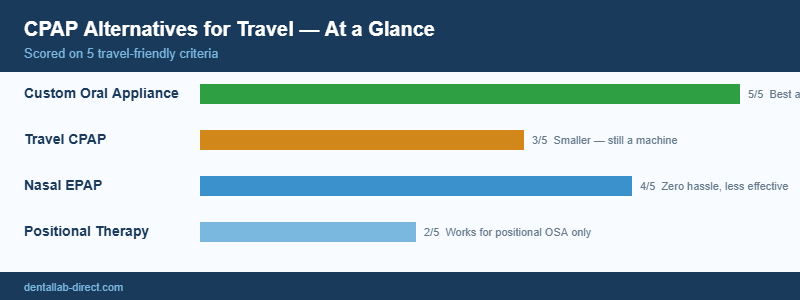
- Travel-friendly has five measurable criteria: size, power requirement, water and maintenance, TSA and airline ease, setup time. Custom oral appliances score perfectly on all five.
- The AASM and AADSM jointly recommend custom-fit oral appliances as a first-line alternative for mild-to-moderate OSA when CPAP isn’t preferred or tolerated.
- The most underused pattern: CPAP at home, oral appliance for the road. Legitimate, AASM-supported for the right cases.
- Severe OSA cases should bring their CPAP. Travel convenience doesn’t outweigh effectiveness for severe disease.
The CPAP that’s still sitting in your closet
75% of sleep apnea patients travel with their CPAP machine [3]. Traveling with sleep apnea isn’t optional, but bringing the machine often is, and most articles in this space don’t explain what the realistic alternatives actually are. Of the 25% who skip the machine, most either skip treatment entirely (which is risky) or have already found something that fits in a bag without a fight.
If you’ve ever lugged a CPAP through TSA, listened to it on a red-eye, or fought with a hotel humidifier fill-cup at midnight, you already know why this article exists. The friction adds up. By night three of a trip, the math starts pushing you toward skipping a night. By night seven, you might be doing it on autopilot.
This isn’t an anti-CPAP article. CPAP is the gold standard for diagnosed OSA, and we’ll tell you when not to substitute it. But for the right cases, a travel-friendly alternative isn’t a compromise. It’s the same Class II clearance, the same clinical evidence, just a device that fits in a Dopp kit.
What “travel-friendly” actually means: 5 criteria
Most articles list options without defining the bar. Here’s the bar.
1. Size and weight. Pocket-able versus carry-on hog. The realistic threshold for compact: fits in a small pouch alongside your travel toiletries.
2. Power requirement. None, battery, or outlet. Outlet-only solutions create friction in hotels, cabins, campsites, and international travel where outlets need adapters.
3. Water, humidifier, and cleaning supplies. CPAPs need distilled water and overnight cleaning windows. Most travel disrupts both. Many travelers skip the humidifier entirely on the road, which compromises comfort.
4. TSA, airline, and hotel friction. TSA allows CPAPs as carry-on without counting them toward your bag limit, per TSA guidance. Inspections still happen. Hotel outlets aren’t always where you’d want them.
5. Setup and breakdown time. Three minutes per night across a 10-day trip is 30 minutes of fiddling you wouldn’t choose to do at home.
The four options below get scored against these five criteria. Then we put them in a side-by-side table.
The four real travel-friendly options
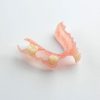
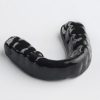
Option 1. Custom oral appliance (mandibular advancement device)
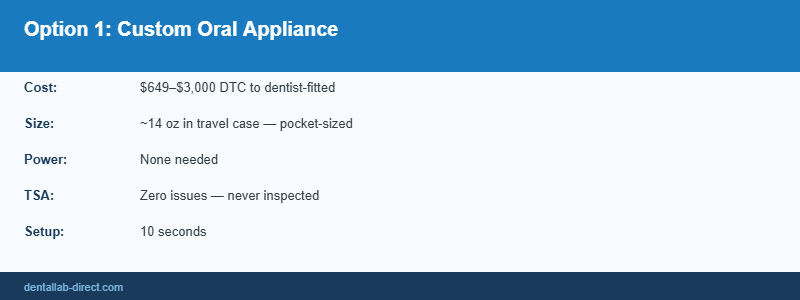
Cost: $600 to $3,000 (DTC custom tier to dentist-fitted). See our OTC vs Custom CPAP Alternatives guide for tier breakdown.
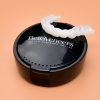
Size and weight: About 14 oz with case. Pocket-sized.
Power: None.
Water/maintenance: Rinse with water after use, store in case. No supplies.
TSA/airline: Zero issues. Never inspected, never restricted.
Setup time: Place in mouth. About 10 seconds.
Right for you if: You have mild-to-moderate OSA, you’re CPAP-intolerant, or you want one device that works for both home and travel.
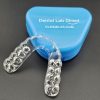
The catch: Needs a prescription. OSA-cleared Class II appliances aren’t sold over the counter. Severe OSA cases need CPAP, not just an oral appliance [1][2]. DLD’s EMA Anti-Snore / Sleep Apnea Device is one example of this category. We make these. See the mid-article callout for specifics.
Option 2. Travel CPAP machine (not a true alternative, but worth covering)
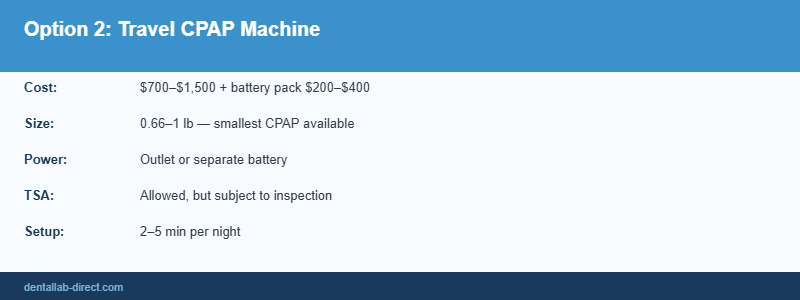
Cost: $700 to $1,500 for the major travel CPAP models. Battery packs add $200 to $400.
Size and weight: 0.66 to 1 lb. Pocket-able as machines go.
Power: Outlet or battery (battery sold separately).
Water: Optional waterless heat-moisture exchanger. Still needs filter changes.
TSA/airline: Allowed as carry-on, doesn’t count toward bag limit per TSA, but still subject to inspection.
Setup time: 2 to 5 minutes per night for mask fit, hose, optional water.
Right for you if: You have severe OSA, you’re already adherent to CPAP, or you don’t want to introduce a new therapy on the road.
The catch: Still a machine. Still has the friction. A smaller CPAP is not freedom from CPAP.
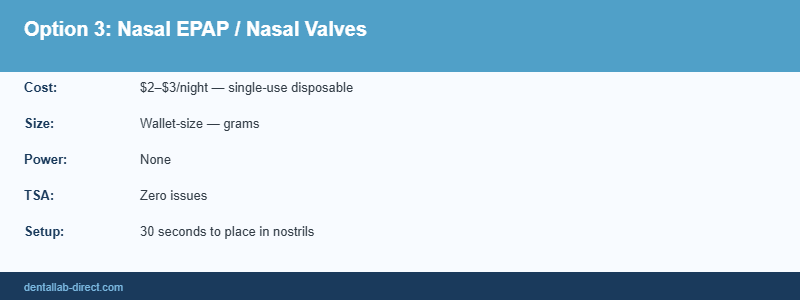
Option 3. Nasal EPAP / nasal valves
Cost: $2 to $3 per night. Single-use disposable.
Size and weight: Tiny. Fits in a wallet. Grams, not ounces.
Power: None.
Water/maintenance: None. Disposable.
TSA/airline: Zero issues.
Setup time: 30 seconds to place in nostrils.
Right for you if: You have mild OSA, you’re on a short trip, or you want a travel-only solution alongside a permanent treatment at home.
The catch: Less effective than custom oral appliances per clinical evidence. Daily cost adds up on longer trips. Some users find them uncomfortable.
Option 4. Positional therapy and lifestyle
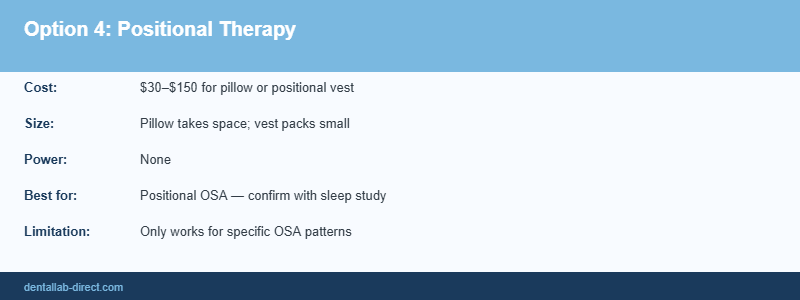
Cost: $30 to $150 for anti-snore pillows, positional vests, or smart sleep trackers.
Size and weight: The pillow takes space. A vest packs small.
Power: None.
Right for you if: You have positional OSA, meaning your apnea events are significantly worse when you sleep on your back.
The catch: Only works for specific OSA patterns. A diagnostic sleep study should confirm positional OSA before relying on this alone.
Side-by-side comparison
| Custom oral appliance | Travel CPAP | Nasal EPAP | Positional therapy | |
|---|---|---|---|---|
| Size/weight | Pocket case, 14 oz | 0.66 to 1 lb machine | Wallet-size, grams | Pillow or small vest |
| Power required | None | Outlet or battery | None | None |
| Water/maintenance | Rinse only | Optional HME, filter swaps | None (disposable) | None |
| TSA/airline | Zero issues | Allowed, but inspected | Zero issues | Zero issues |
| Setup time | 10 seconds | 2 to 5 minutes | 30 seconds | Sleeping position |
| Mild-mod OSA evidence | First-line per AASM [2] | Standard of care | Approved, lower-tier | Limited cases only |
| Cost | $600 to $3,000 | $700 to $1,500 | $2 to $3 per night | $30 to $150 |
The lightest sleep apnea solution you’ll ever pack.
DLD’s EMA device fits in a Dopp kit, needs no outlet, and clears TSA in seconds. Custom-fit from your at-home impression, shipped direct from the lab. Starting at $649 — or four payments of $162.25.
The honest carve-out: when to bring the CPAP
This route doesn’t replace CPAP for every case. If any of the following apply, don’t downgrade your therapy for travel convenience.
- Severe OSA (AHI greater than 30 per your sleep study)
- High-altitude travel above ~8,000 feet, where oxygen pressure drops and apnea events increase
- New diagnosis or recent therapy changes. Don’t introduce more variables mid-trip
- High-stakes work travel where compromised sleep has real performance consequences
We’ll say this directly because most articles in this space won’t. If you’re in one of those cases, bring the CPAP. Travel CPAPs are small, allowed by TSA, and don’t count toward your bag limit. The friction is worth it.
The double-life pattern: CPAP at home, oral appliance for the road
Here’s the pattern most travel articles miss.
A meaningful chunk of CPAP users keep their machine at home and use an oral appliance only when they travel. The AASM and AADSM clinical practice guideline supports this pattern for mild-to-moderate OSA when home CPAP adherence is solid [2]. You get the gold-standard treatment at home, and a Class II travel solution that doesn’t add airline friction.
The lab-side perspective: a single custom oral appliance lasts 3 to 5 years. Buying one solution that serves both as a permanent backup and a travel-friendly device is the same purchase. We see this pattern weekly. Customers with CPAP closets and oral appliance go-bags.
Ready to Sleep Better Without the Machine?
Dental Lab Direct custom-makes your oral appliance the same way your sleep dentist does — but ships direct from the lab, cutting out the overhead.
70% less than the dentist. Custom fit. Ships to your door.
Starting at $649 · Only four payments of $162.25 · About 3–4 weeks to your door
What to do next, based on your situation
Which path makes sense depends on where you’re starting from. Five common situations, with what’s typically recommended.
- You’re an established CPAP user, looking for a travel-only alternative. Custom oral appliance is the most-studied option. For mild-to-moderate OSA, the DTC custom tier is the cost-savvy fit. Keep using CPAP at home for AHI control [2].
- You snore on trips but have never been formally tested. Get a sleep test first. Travel exacerbates symptoms (alcohol, altitude, weight changes) but doesn’t itself indicate OSA. Once you have a diagnosis, come back and pick the tier that fits.
- You have mild-to-moderate OSA already diagnosed. A custom oral appliance works for both home and travel. You don’t need two solutions. The DTC tier saves you over $1,500 versus in-office fitting.
- You have severe OSA. Bring the CPAP. Travel CPAPs are smaller, allowed by TSA, and don’t count toward your bag limit. Severe OSA is the wrong condition to compromise on during travel.
- You’re already using an OTC anti-snore mouthpiece for travel and it’s not cutting it. Fit is the issue, not the concept. Upgrading to a custom oral appliance solves the fit problem at the same form factor. Our OTC vs Custom CPAP Alternatives guide covers the tier comparison in detail.
Different travel pattern not covered above?
If your situation doesn’t fit neatly into one of these (maybe you’re a flight attendant with shift work, you split time between two cities, or your trips routinely involve high altitude), our support team can think it through with you. Call 1-888-591-2220 or reach out through our contact page.
FAQ
- Can I skip my CPAP for one night while traveling?
Some patients notice symptoms returning even after a single missed night (daytime fatigue, snoring, morning headaches), though clinical evidence on how quickly effects appear varies. For most patients, occasional missed nights pose limited short-term risk. The larger concern is cumulative non-adherence across a longer trip, which is well-documented in OSA outcome literature. Having an alternative on hand reduces the temptation to skip when the friction gets high.
- Is an oral appliance as effective as CPAP for travel use?
For mild-to-moderate OSA, the AASM/AADSM 2015 guideline recommends custom oral appliances as a first-line alternative when CPAP isn’t preferred or tolerated [2]. For severe OSA, CPAP remains the gold standard and shouldn’t be substituted for travel convenience.
- How small is a custom oral appliance?
A typical mandibular advancement device weighs about 14 oz with its case. Fits in a Dopp kit, a small zipped pouch, or a jacket pocket.
- Do I need a prescription to buy a travel CPAP alternative?
OTC anti-snore mouthpieces and nasal stents don’t require a prescription but are FDA-cleared for snoring only, not OSA. Custom oral appliances and travel CPAPs require a prescription because they’re Class II medical devices indicated for OSA treatment [1].
- What should I know about traveling with sleep apnea at altitude?
For many patients, sleep apnea events increase at altitude due to lower oxygen pressure. If you’re traveling to elevations above ~8,000 feet, bring your CPAP even if you’d consider skipping it at sea level. Altitude is one of the clearer cases where travel convenience doesn’t outweigh treatment effectiveness.
- Are nasal EPAP devices a real treatment or just for short-term use?
They’re FDA-cleared for OSA, but clinical effectiveness varies widely by user. They’re best as a travel supplement, not a permanent replacement for CPAP or custom oral appliances in moderate-to-severe cases.
25+ years as a commercial dental lab. FDA-approved materials. Made in coordination with licensed dentists. 1,000+ verified reviews. 60-day warranty on all custom-made products.
If you’re ready for a travel-friendly oral appliance
DLD’s EMA Anti-Snore / Sleep Apnea Device is FDA-cleared Class II, custom-fit from an at-home impression. Weighs about 14 oz with case. No batteries, no water, TSA-friendly.
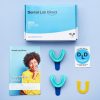
Process: order online. At-home impression kit ships in a few days. Mail it back. Custom appliance arrives in about three to four weeks. We handle the sleep test and prescription through our partnered telehealth provider if you need one.
No outlets. No water. No mask straps.
View the EMA Anti-Snore / Sleep Apnea Device →
Sources
[1] FDA Product Classification Database. Product Code LRK: Intraoral devices for snoring and/or obstructive sleep apnea. Class II. accessdata.fda.gov
[2] Ramar K, Dort LC, Katz SG, et al. Clinical Practice Guideline for the Treatment of Obstructive Sleep Apnea and Snoring with Oral Appliance Therapy: An Update for 2015. Journal of Clinical Sleep Medicine 2015;11(7):773-827. AASM/AADSM joint guideline. jcsm.aasm.org
[3] SleepApnea.org. 75% of People with Sleep Apnea Travel with their CPAP Machines. sleepapnea.org
[4] TSA.gov. Special procedures for travelers with CPAP machines and medical devices. tsa.gov
[5] American Academy of Sleep Medicine. Clinical Practice Guideline for Diagnostic Testing for Adult Obstructive Sleep Apnea. aasm.org