Summary
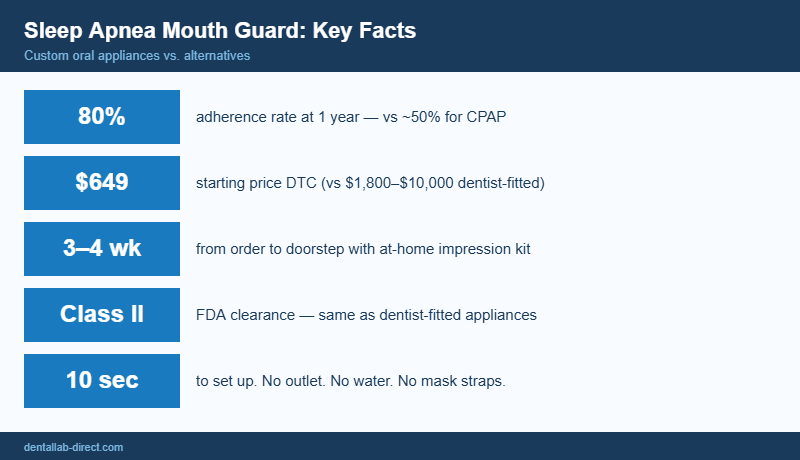
- A sleep apnea mouth guard, sometimes called a sleep apnea mouthpiece, is a custom-fit mandibular advancement device (MAD): an FDA Class II medical device that holds the lower jaw forward during sleep to keep the airway open for treatment of obstructive sleep apnea (OSA).
- Custom-fit beats boil-and-bite on both effectiveness and comfort. The American Academy of Sleep Medicine (AASM) and the American Academy of Dental Sleep Medicine (AADSM) jointly recommend custom over non-custom oral appliances for OSA.
- Adherence is the quiet advantage. Oral appliance therapy holds about 80% adherence at one year. Continuous Positive Airway Pressure (CPAP) adherence is lower, which is why long-term health outcomes between the two are often similar despite oral appliances reducing the apnea-hypopnea index (AHI) less per night.
- The materials matter: FDA-cleared medical-grade thermoplastics, hypoallergenic, BPA-free. Cheap acrylic doesn’t survive three to five years of nightly grinding. The right material does.
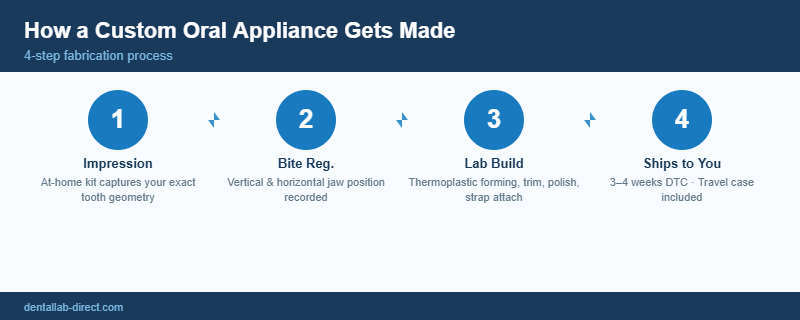
- The fabrication process: impression (at-home or in-office), lab forming, bite registration, quality control, three to four week turnaround for a direct-to-consumer (DTC) custom appliance.
- Custom sleep apnea mouth guards require a prescription because they’re Class II OSA-indicated devices. Over-the-counter (OTC) anti-snore mouthpieces are cleared for snoring only.
- Fit precision matters more than brand or marketing. Generic “best mouthpiece” lists miss the variable that actually determines whether the device works for you: your specific anatomy.
What a sleep apnea mouth guard actually is
You’ve decided you want a mouth guard for sleep apnea. Or you’re figuring out whether one would actually work for your case. Either way, you’re already past the part where most articles start, which is why we’re skipping the “sleep apnea is a serious condition” intro.
This article isn’t a survey of treatment options. It’s about the device itself: how a mouth guard for sleep apnea works mechanically, what’s inside one, how a real custom appliance gets made, and why fit precision is the variable that actually matters.
We’ve been making these for over two decades. Here’s what we know that most articles in this space don’t say.
How a sleep apnea mouth guard works (the mechanism)
Obstructive sleep apnea (OSA) is what happens when the soft tissues of the upper airway, the back of the tongue and the soft palate, collapse during sleep and block breathing. It’s worse on your back and worse during the deeper stages of sleep when muscle tone is lowest.
A mandibular advancement device (MAD) addresses this mechanically. By holding the lower jaw forward by a calibrated amount, the device pulls the tongue forward, which keeps the posterior airway open. The typical therapeutic range is four to eight millimeters of advancement, depending on your anatomy and the severity of your apnea.
Why precise calibration matters: too little advancement and the airway still collapses overnight. Too much and you get jaw soreness in the morning, gradual bite changes over months, and stress on the temporomandibular joint. The right amount of advancement is specific to your bite, your jaw structure, and your apnea pattern. A generic mouthpiece advancing your jaw five millimeters might be perfect for one person and useless for another with a different bite class.
This is why fit precision is the variable that matters more than design features, brand names, or material thickness. The amount and position of advancement is what determines whether the device works.
The materials inside a custom oral appliance
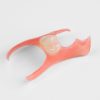
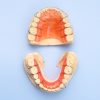
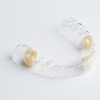
A custom-made sleep apnea mouth guard isn’t a single piece of plastic. It’s an assembly of medical-grade thermoplastic shells with carefully chosen mechanisms that lock the upper and lower trays into the right relative position.
Medical-grade thermoplastic. The base material is a clear, durable resin that resists nightly grinding. It holds dimensional stability for three to five years, doesn’t soften under saliva or warm temperatures, and doesn’t shed plasticizers into your mouth over time.
BPA-free and hypoallergenic. Required by the FDA for Class II intraoral devices [1]. Cheaper imported devices often skip this standard.
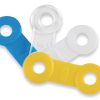
Elastic strap mechanisms. In EMA-class devices like the one DLD makes, the upper and lower trays connect through interchangeable elastic straps of varying tension. This design lets the wearer adjust advancement at home by swapping the strap, instead of sending the device back to the lab for re-titration.
What dollar-store mouthpieces are made of: lower-grade thermoplastic that softens, distorts, or harbors bacteria over months. Which is why a $20 boil-and-bite typically needs replacement in six to twelve months while a medical-grade custom appliance lasts three to five years.
How a custom oral appliance gets made
Step 1: Impression. At-home impression kits or in-office impressions capture the geometry of your upper and lower teeth. Better impressions mean better fit. We provide the kit with pre-measured impression putty so you don’t have to mix anything.
Step 2: Bite registration. The vertical and horizontal position of your jaw is recorded so the device locks into the right advancement amount. This is the step generic OTC mouthpieces skip entirely.
Step 3: Lab fabrication. Thermoplastic forming, trim, polish, strap attachment for EMA-class devices, and quality control inspection. We’ve shipped hundreds of these every month for over twenty years. The process is the same whether the device is going to a sleep dentist’s office or directly to a patient.
Step 4: Shipment and titration. The device ships in a case. You insert the included strap. After two to four weeks of wear, you can swap to a different-tension strap to adjust advancement based on comfort and effectiveness.
Total turnaround: about three to four weeks at the direct-to-consumer (DTC) tier. In-office tiers run four to eight weeks with multiple titration appointments built in.
Custom vs OTC sleep apnea mouth guards (why the difference matters)
Custom. Precise jaw advancement based on your specific impression. Medical-grade thermoplastic. Three to five year lifespan. FDA-cleared for both snoring and OSA.
Over-the-counter (OTC) boil-and-bite. Generic fit you form yourself with hot water. Lower-grade thermoplastic. Six to twelve month lifespan. FDA-cleared for snoring only, not OSA.
The American Academy of Sleep Medicine (AASM) and American Academy of Dental Sleep Medicine (AADSM) 2015 clinical practice guideline explicitly recommends custom-fabricated over non-custom oral appliances for OSA treatment [2]. The reasoning is mechanical: precise calibrated advancement requires custom fit, and generic devices can’t reliably deliver it.
A 2008 trial in American Journal of Respiratory and Critical Care Medicine compared custom and thermoplastic (boil-and-bite) appliances head-to-head in patients with mild OSA. The thermoplastic devices failed to reduce the apnea-hypopnea index in roughly two-thirds of participants, with substantially higher dropout rates [3].
For snoring-only cases without an OSA diagnosis, an OTC device may help. For diagnosed OSA, custom is the standard the clinical evidence supports.
Side-by-side comparison
| OTC boil-and-bite | DTC custom (telehealth Rx) | Dentist-fitted custom | |
|---|---|---|---|
| Cost | $30 to $150 | $600 to $900 all-in | $1,800 to $10,000 |
| Prescription | Not required | Required (telehealth) | Required (in-office) |
| FDA indication | Snoring only | Snoring + OSA | Snoring + OSA |
| Fit | Generic, self-formed | Custom from at-home impression | Custom from in-office impression |
| Materials | Lower-grade thermoplastic | Medical-grade, BPA-free | Medical-grade, BPA-free |
| Adjustability | Limited | High (interchangeable strap strengths) | High (titrated in-office) |
| Lifespan | 6 to 12 months | 3 to 5 years | 3 to 5 years |
| AASM/AADSM recommendation | Not recommended for OSA | First-line for mild-to-moderate OSA | First-line for mild-to-moderate OSA |
Custom-fit at lab prices. No dentist appointment.
Dental Lab Direct ships custom-made sleep apnea mouth guards directly from our certified lab — right to your door. No office visits. No waiting rooms. Save $1,800 or more compared to what you’d pay at a dental sleep medicine office.
DLD’s EMA Anti-Snore / Sleep Apnea Device sits at $649 starting, near the low end of the DTC custom range above.
The quiet advantage: adherence
Most Continuous Positive Airway Pressure (CPAP) vs oral appliance debates focus on apnea-hypopnea index (AHI) reduction. CPAP wins that comparison on average, by a meaningful margin.
But long-term cardiovascular outcomes (blood pressure, endothelial function, vascular reactivity) come out similar between the two treatments. Why?
Adherence. Oral appliance therapy holds about 80% adherence at three months and one year. CPAP adherence numbers are notoriously lower. The clinical literature frames this directly: “inferior efficacy counterbalanced by superior adherence resulting in similar effectiveness” [4].
What that means in practice: a “less effective” treatment that you actually use every night may outperform a “more effective” treatment that spends half the week sitting on the nightstand. Especially for mild-to-moderate OSA, where the marginal AHI advantage of CPAP matters less than consistent use.
The honest carve-out: this isn’t a free pass for severe OSA. If your AHI is in the severe range, CPAP or surgical options like hypoglossal nerve stimulation remain the standard of care. The adherence advantage of oral appliances matters most in the mild-to-moderate zone.
Ready to Sleep Better Without the Machine?
Dental Lab Direct custom-makes your oral appliance the same way your sleep dentist does — but ships direct from the lab, cutting out the overhead.
70% less than the dentist. Custom fit. Ships to your door.
Starting at $649 · Only four payments of $162.25 · About 3–4 weeks to your door
Is a custom sleep apnea mouth guard right for you, and what ordering looks like
It’s a fit if…
- You’ve been diagnosed with mild-to-moderate obstructive sleep apnea
- You can’t tolerate CPAP, or you’ve tried it and stopped
- You snore loudly and your partner is the one pushing the issue (you should still get tested first to confirm OSA vs simple snoring)
- You want one device that works for both home and travel
- You want the clinical-grade option without the dentist-office price
It’s not a fit if (and what to do instead)
- You have severe OSA (AHI greater than 30 on your sleep study). Custom oral appliances aren’t first-line for severe disease. Talk to your sleep physician about CPAP, BiPAP, or surgical options.
- You have complex bite issues, jaw-joint disorders, or extensive dental work in the bite area. An in-office sleep dentist should evaluate before you order anything custom.
- You haven’t been tested yet. Get a sleep study (at-home options run $79 to $219) before buying anything. Treating undiagnosed OSA with a snoring device addresses the symptom and leaves the condition.
- You’ve already failed oral appliance therapy with a properly-fitted custom device. That’s an indication that your case needs something different, and another DTC custom appliance probably won’t change that outcome.
What ordering from DLD looks like
- Place your order online.
- The at-home impression kit arrives in a few days, pre-loaded with impression putty.
- Take your impressions following the included instructions. Mail them back in the pre-paid USPS return envelope.
- Our lab fabricates your custom EMA device. Three to four weeks.
- Your finished appliance ships in a travel case. Insert the included elastic strap and wear at night.
If you need a prescription because you haven’t had one written, we handle that through our partnered telehealth sleep test pathway. Results come back in about 48 hours.
Still not sure if this is the right path for your specific case?
If your situation has wrinkles (multiple medical conditions, dental implants near the bite area, prior failed oral appliance therapy, a partner pushing the issue while you’re still figuring out whether you have OSA), our support team can talk you through it. We’ll point you to the right next step even when that step isn’t ordering from us. Call 1-888-591-2220 or reach out through our contact page.
FAQ
- What’s the difference between an OTC mouth guard and a custom sleep apnea mouth guard?
FDA indication and fit precision. OTC mouth guards are cleared for snoring only. Custom appliances are cleared for both snoring and OSA. OTC uses boil-and-bite generic fit; custom is fabricated from your specific impression.
- How much does a custom sleep apnea mouth guard cost?
$600 to $900 all-in for DTC custom (including the telehealth prescription pathway). $1,800 to $10,000 for dentist-fitted, depending on practice and insurance. DLD’s EMA starts at $649.
- Do I need a prescription for a custom sleep apnea mouth guard?
Yes. OSA-cleared Class II appliances require a prescription regardless of where you buy them [1]. Telehealth makes the prescription pathway less friction than it used to be.
- How long does a sleep apnea mouth guard last?
A medical-grade custom appliance typically lasts three to five years. OTC boil-and-bite devices typically last six to twelve months before the fit degrades.
- Are oral appliances as effective as CPAP for sleep apnea?
CPAP reduces AHI more per night on average. But oral appliance adherence is significantly higher, and long-term cardiovascular outcomes are often comparable for mild-to-moderate OSA, attributed to the adherence difference [4].
- How long does it take to get used to a sleep apnea mouth guard?
Most patients adapt within one to two weeks. Common adjustment-period side effects include drooling, mild jaw soreness in the morning, or tender teeth. These typically resolve as the jaw settles into the new advanced position.
- What makes the best mouth guard for sleep apnea?
The best mouth guard for sleep apnea isn’t a single product but a combination of three factors: custom fit from your specific impression, FDA Class II clearance for OSA (not just snoring), and medical-grade BPA-free materials. The same criteria apply if you’re searching for the best sleep apnea mouthpiece. A device that meets all three is a legitimate clinical-grade option; a $30 drugstore boil-and-bite meets none of them.
25+ years as a commercial dental lab. FDA-approved medical-grade materials. Made in coordination with licensed dentists. 1,000+ verified reviews. 60-day warranty on all custom-made products.
If you’re ready for a custom sleep apnea mouth guard
DLD’s EMA Anti-Snore / Sleep Apnea Device is a custom-made mandibular advancement device, FDA-cleared as a Class II appliance for both OSA and snoring. Medical-grade BPA-free thermoplastic. Made by our lab the same way it’s made for sleep dentists’ offices, with the same materials and the same quality control.
Our EMA starts at $649, which puts it at the bottom of the DTC custom range we quoted earlier and well under half of typical dentist-fitted pricing. About three to four weeks from your impression to delivery.
Real materials. Real fit. Real fabrication.
View the EMA Anti-Snore / Sleep Apnea Device →
Sources
[1] FDA Product Classification Database. Product Code LRK: Intraoral devices for snoring and/or obstructive sleep apnea. Class II. accessdata.fda.gov
[2] Ramar K, Dort LC, Katz SG, et al. Clinical Practice Guideline for the Treatment of Obstructive Sleep Apnea and Snoring with Oral Appliance Therapy: An Update for 2015. Journal of Clinical Sleep Medicine 2015;11(7):773-827. AASM/AADSM joint guideline. jcsm.aasm.org
[3] Vanderveken OM, Devolder A, Marklund M, et al. Comparison of a Custom-made and a Thermoplastic Oral Appliance for the Treatment of Mild Sleep Apnea. American Journal of Respiratory and Critical Care Medicine 2008;178(2):197-202.
[4] Phillips CL, Grunstein RR, Darendeliler MA, et al. Long-Term Effectiveness of Oral Appliance versus CPAP Therapy and the Emerging Importance of Understanding Patient Preferences. Sleep / PubMed Central. PMC3738032
[5] Cleveland Clinic. Oral Appliance Therapy for Sleep Apnea. my.clevelandclinic.org