Summary
- OTC anti-snore mouthpieces are FDA-cleared for snoring, not for diagnosed obstructive sleep apnea (OSA). The regulatory line is real, and treating them as interchangeable wastes money and time.
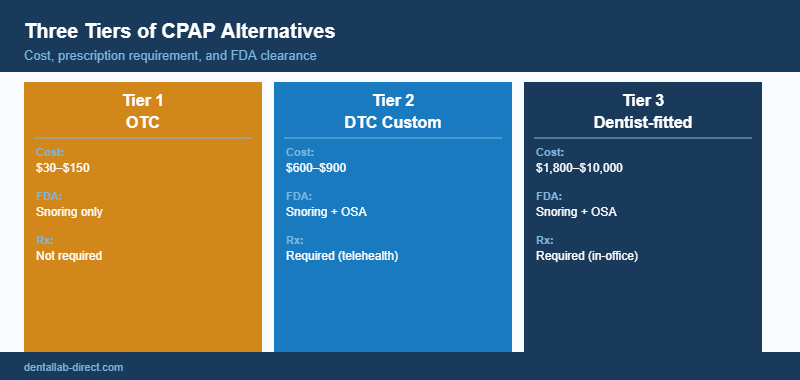
- The CPAP-alternative market has three tiers, not two: OTC ($30 to $150), DTC custom with telehealth prescription ($600 to $900 all-in), and dentist-fitted custom ($1,800 to $10,000).
- All three tiers carry the same FDA Class II classification. What separates them isn’t the device. It’s the indication, the fit precision, and the distribution model.
- The DTC custom tier exists because dental labs have always made these appliances. They only recently started shipping direct, skipping the office overhead that drives most of the price gap.
- The AASM and AADSM jointly recommend custom-fit oral appliances over non-custom (boil-and-bite) devices for treating OSA.
- If you’ve been diagnosed with sleep apnea, you need a Class II prescription appliance. Whether you get it from a dentist office or a lab-direct service is the real question.
- Most products marketed as over-the-counter CPAP alternatives or non-prescription CPAP alternatives are cleared only for snoring, not for diagnosed sleep apnea. The distinction is regulatory, not marketing.
Forty dollars to three thousand dollars for the same idea
$40 anti-snore mouthpiece on Amazon. $3,000 at the sleep dentist. Both promise to replace your CPAP.
You’re on the market because something didn’t work, or you’re trying to skip a step you don’t think you need. Most people searching for over-the-counter CPAP alternatives are doing one of two things: trying to bypass a CPAP they can’t tolerate, or trying to avoid the medical system entirely. Maybe a sleep study told you what you already suspected, and the CPAP machine they sent home has been sitting on a nightstand mostly unused. Maybe your partner has stopped pretending the snoring is fine. Maybe you’ve already bought a $20 boil-and-bite from a drugstore and slept worse, not better.
Here’s the thing most people miss: there are three tiers of CPAP alternatives, not two. And the cheapest one is often the most expensive way to find out it doesn’t work for you.
The three tiers of CPAP alternatives
The CPAP-alternative market splits into three tiers, separated less by what the device does and more by how you get one. The first decision is which tier you’re actually shopping in, and most articles skip it entirely.
Tier 1. Over-the-counter anti-snore devices
Cost: $30 to $150.
What they are: Boil-and-bite mouthpieces, nasal dilators, anti-snore pillows, mouth tape, tongue-retaining devices.
Prescription: Not required.
FDA classification: Class II, cleared for snoring [1].
Fit: Generic. You form the device yourself by softening it in hot water and biting down.
Right for you if: You snore occasionally, you haven’t been diagnosed with sleep apnea, you want to test whether any oral device helps you before spending more.
The catch: OTC clearance covers snoring, not obstructive sleep apnea. If you’ve been diagnosed with OSA, an over-the-counter CPAP alternative isn’t a treatment. It’s a placeholder. Most products sold under that label are anti-snore devices first, anything else second.
Tier 2. Direct-to-consumer custom oral appliances
Cost: $600 to $900 all-in, including the sleep-test and prescription pathway.
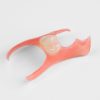
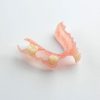
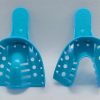
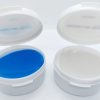
What they are: The same FDA Class II custom oral appliances dental labs have been making for decades, ordered online. At-home impression kit, telehealth-facilitated prescription, mailed device.
Prescription: Required. Usually facilitated through a partnered telehealth sleep-test service.
FDA classification: Class II, cleared for both snoring and OSA [1].
Fit: Custom, taken from your own at-home impression.
Right for you if: You’ve been diagnosed with mild-to-moderate sleep apnea, you can’t tolerate CPAP or never started, you want the clinical-grade device without the in-office price.
The catch: A prescription is non-negotiable for OSA-cleared appliances. You’ll need either a current sleep study or an at-home test before ordering. Severe OSA cases usually need more clinical oversight than DTC provides.
Tier 3. Dentist-fitted custom oral appliances
Cost: $1,800 to $10,000, depending on practice, region, and insurance.
What they are: The same FDA Class II custom oral appliances, fitted in a dental sleep medicine office.
Prescription: Required, written by the treating dentist.
FDA classification: Class II, cleared for both snoring and OSA [1].
Fit: Custom, taken from in-office impressions, often with multiple titration appointments.
Right for you if: Your insurance reimburses dental sleep medicine well, your case is complex (severe OSA, jaw-joint issues, complex bite, implants near the bite area), you want hands-on follow-up.
The catch: Most of what you’re paying for isn’t the appliance. It’s the office overhead. Chair time, lease, billing department, follow-up appointments, and the dentist’s time. Those costs are real. They’re just not in the device.
What FDA clearance actually means
All three tiers play in the same FDA bucket: Class II medical devices for intraoral use. The Class doesn’t change. What changes is the indication.
OTC devices are cleared for snoring. Not for sleep apnea. The distinction isn’t marketing. It’s regulatory [1]. An anti-snore mouthpiece sold without a prescription is allowed to claim it reduces snoring noise. It is not allowed to claim it treats obstructive sleep apnea.
Custom oral appliances in Tier 2 and Tier 3 carry both indications. Same Class II clearance, broader claims, prescription required. The prescription requirement exists for a reason: OSA is a diagnosed medical condition, and the appliance needs to advance the lower jaw by a calibrated amount specific to your anatomy. That calibration is what separates a snoring-noise-reducer from an actual airway treatment.
Can over-the-counter anti-snore devices actually treat sleep apnea?
Short answer: no.
The American Academy of Sleep Medicine and the American Academy of Dental Sleep Medicine published a joint clinical practice guideline in 2015 that’s still the standing recommendation. For adults with OSA who can’t tolerate CPAP or prefer an alternative, the guideline recommends custom, titratable oral appliances over non-custom (boil-and-bite) options [2].
The reasoning is mechanical. Oral appliance therapy works by holding the lower jaw forward during sleep, which keeps the airway open. Too little advancement, and the airway still collapses. Too much, and your jaw aches in the morning while your bite shifts over months of use. The correct position is specific to your anatomy. Boil-and-bite mouthpieces don’t reach that position with any precision.
A 2008 head-to-head trial in American Journal of Respiratory and Critical Care Medicine compared custom and thermoplastic (boil-and-bite) appliances in patients with mild OSA. The thermoplastic device failed to reduce the apnea-hypopnea index in roughly two-thirds of participants. Dropout rates were higher too [3].
The pattern from the research: OTC for snoring may work for some people. OTC for diagnosed OSA usually doesn’t, and trying it first often delays real treatment by months.
Side-by-side comparison
| OTC anti-snore | DTC custom (telehealth Rx) | Dentist-fitted custom | |
|---|---|---|---|
| Typical cost | $30 to $150 | $600 to $900 all-in | $1,800 to $10,000 |
| Prescription | Not required | Required (telehealth-facilitated) | Required (from dentist) |
| FDA classification | Class II, cleared for snoring | Class II, cleared for OSA + snoring | Class II, cleared for OSA + snoring |
| Fit | Boil-and-bite, generic | Custom from at-home impression | Custom from in-office impression |
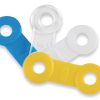
| Adjustability | Limited or none | High (e.g., interchangeable strap strengths) | High (titrated in-office) |
| Time to use | Same day | 3 to 4 weeks | 4 to 8 weeks plus multiple visits |
| Lifespan | 6 to 12 months | 3 to 5 years | 3 to 5 years |
| Insurance | Rarely covered | Some plans plus HSA/FSA eligible | Most plans cover |
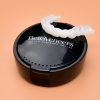
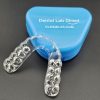
The DTC custom tier — what it actually looks like.
Dental Lab Direct ships custom-made FDA Class II oral appliances direct from our lab to your door. Same device your sleep dentist orders. Save $1,800 or more. Telehealth Rx pathway included if you need it.
Why the DTC custom tier exists at all
Here’s what the dental office isn’t pricing in.
Dental labs have been making custom oral appliances for decades. The same lab that ships a $300 to $500 custom appliance to a sleep dentist’s office is the lab whose work eventually shows up in a patient’s mouth. The dentist marks the device up. Sometimes a little, sometimes 5 or 10 times the lab cost.
That markup isn’t pure profit. It pays for the office: front desk, hygienist time, lease, equipment, insurance billing, follow-up appointments, and the dentist’s own time. Those costs are real. For some patients they’re worth paying, especially when insurance covers most of it.
But the lab’s part of the equation, the actual making of the appliance, doesn’t change between tiers. FDA-approved thermoplastic materials are the same. The impression-to-device workflow is the same. Class II clearance is the same. We know this because we are that lab. Our techs ship hundreds of these appliances every month, and the box that goes to a dentist office is the same box that goes to a patient ordering direct.
What changed recently is the regulatory and technological space around telehealth. At-home impression kits got reliable enough to ship by mail. At-home sleep tests got accurate enough to diagnose OSA in non-complex cases [4]. State-by-state telehealth rules normalized enough that a licensed clinician can review your sleep study and write a prescription remotely.
That’s why a DTC custom tier exists now and didn’t five years ago. The device hasn’t changed. The path to getting it has.
The honest carve-out. This route doesn’t replace your dentist for every case. If you have severe OSA, complex bite issues, jaw-joint disorders, dental implants in the appliance bite area, or you’ve already tried oral therapy and it failed, you need an in-office sleep dentist working with your case. We’re not going to pretend otherwise, and we’ll tell you so on the phone if you call us.
Ready to Sleep Better Without the Machine?
Dental Lab Direct custom-makes your oral appliance the same way your sleep dentist does — but ships direct from the lab, cutting out the overhead.
70% less than the dentist. Custom fit. Ships to your door.
Starting at $649 · Only four payments of $162.25 · About 3–4 weeks to your door
What to do next, based on your situation
Which path makes sense depends on where you’re starting from. Here are the five most common situations, with what’s typically recommended.
- You’ve been diagnosed with mild-to-moderate sleep apnea. Custom oral appliance therapy is on-label first-line treatment for mild-to-moderate OSA when CPAP isn’t preferred or tolerated [2]. The DTC custom tier fits cleanly here if you have a current sleep study, or if you’re willing to do an at-home test for prescription purposes.
- You’ve been diagnosed with severe sleep apnea. Custom oral appliance therapy alone usually isn’t the right call for severe OSA. CPAP, BiPAP, or surgical options (including the Inspire implant for select cases) are typically where treatment starts. Your sleep physician or a dental sleep medicine specialist should be your first stop. Buying a Tier 2 appliance for a severe case is the wrong call, and we’ll tell you that too.
- You snore loudly or regularly but have never been tested. Get a sleep test before buying anything. At-home sleep tests are accurate enough for diagnosis in most non-complex cases and run $79 to $219 depending on the provider. Once you have a result, come back to this article and pick the tier that matches.
- You tried CPAP and couldn’t stick with it. You’re not unusual. CPAP non-adherence is the most common reason patients end up reading articles like this one. The AASM/AADSM guideline recommends custom oral appliances as the alternative for CPAP-intolerant patients with mild-to-moderate OSA [2]. If your case is mild-to-moderate, the DTC custom tier is the cost-savvy fit. If your case is more severe, talk to your sleep physician about Inspire or another modality.
- You tried an over-the-counter mouthpiece and it didn’t work. The most likely reason is fit, not the concept. Generic boil-and-bite can’t reliably deliver the calibrated mandibular advancement OSA treatment needs. Stepping up to a custom-fit appliance solves the fit problem without abandoning the underlying idea.
Still not sure which scenario fits you?
If it’s a different situation entirely, yours or someone you know’s, our support team can help you think it through. We’ll point you to the right tier even when that tier isn’t us. Call 1-888-591-2220 or reach out through our contact page.
FAQ
- Is there a non-prescription CPAP alternative that actually works?
For snoring alone, yes – over-the-counter CPAP alternatives like boil-and-bite anti-snore mouthpieces and nasal dilators are cleared for that purpose. For diagnosed obstructive sleep apnea, no – the FDA classification draws that line clearly: Class II OSA-indicated devices require a prescription regardless of where you buy them [1].
- Do over-the-counter mouthpieces work for sleep apnea?
The clinical evidence says they’re substantially less effective than custom-fit appliances for diagnosed OSA. The AASM/AADSM 2015 guideline recommends custom over non-custom oral appliances for this reason [2].
- What’s the difference between an anti-snore mouthpiece and a sleep apnea device?
The FDA indication is the main difference. Anti-snore mouthpieces are cleared to reduce snoring noise. Sleep apnea devices (oral appliance therapy) are cleared to treat the underlying airway collapse. Custom oral appliances usually carry both indications. OTC devices typically carry only the snoring indication.
- How much does a custom oral appliance cost compared to CPAP?
A CPAP machine runs $500 to $3,000 plus ongoing supply costs for masks, tubing, and filters. A custom oral appliance runs $600 to $900 in the DTC tier or $1,800 to $10,000 in the dentist-fitted tier, with no ongoing supplies beyond occasional replacement straps or relines.
- Are oral appliances covered by insurance?
Often yes when fitted by an in-network dentist. DTC appliances are sometimes reimbursed depending on your plan, and HSA and FSA funds usually cover them. The best move is to call your insurance and ask about reimbursement for code E0486 (oral device for OSA).
- How do I know if I have sleep apnea, or if I just snore?
Common OSA symptoms include witnessed pauses in breathing, gasping or choking awake, severe daytime sleepiness, morning headaches, and difficulty concentrating. Snoring alone may not indicate OSA, but the only way to know for sure is a sleep test.
25+ years as a commercial dental lab. FDA-approved materials. Made in coordination with licensed dentists. 1,000+ verified reviews. 60-day warranty on all custom-made products.
If you’re ready for the custom tier
If you’ve decided custom oral appliance therapy is your next step and the DTC tier fits your situation, here’s how it works at DLD. Order online. Get your at-home impression kit in a few days. Mail it back. Receive your custom appliance in about three to four weeks. We handle the sleep test and prescription through our partnered telehealth provider when you need one.
No office. No markup. No compromise on fit.
View the EMA Anti-Snore / Sleep Apnea Device →
Sources
[1] FDA Product Classification Database. Product Code LRK: Intraoral devices for snoring and/or obstructive sleep apnea. Class II. accessdata.fda.gov
[2] Ramar K, Dort LC, Katz SG, et al. Clinical Practice Guideline for the Treatment of Obstructive Sleep Apnea and Snoring with Oral Appliance Therapy: An Update for 2015. Journal of Clinical Sleep Medicine 2015;11(7):773-827. AASM/AADSM joint guideline. jcsm.aasm.org
[3] Vanderveken OM, Devolder A, Marklund M, et al. Comparison of a Custom-made and a Thermoplastic Oral Appliance for the Treatment of Mild Sleep Apnea. American Journal of Respiratory and Critical Care Medicine 2008;178(2):197-202.
[4] American Academy of Sleep Medicine. Clinical Practice Guideline for Diagnostic Testing for Adult Obstructive Sleep Apnea. aasm.org