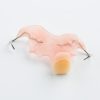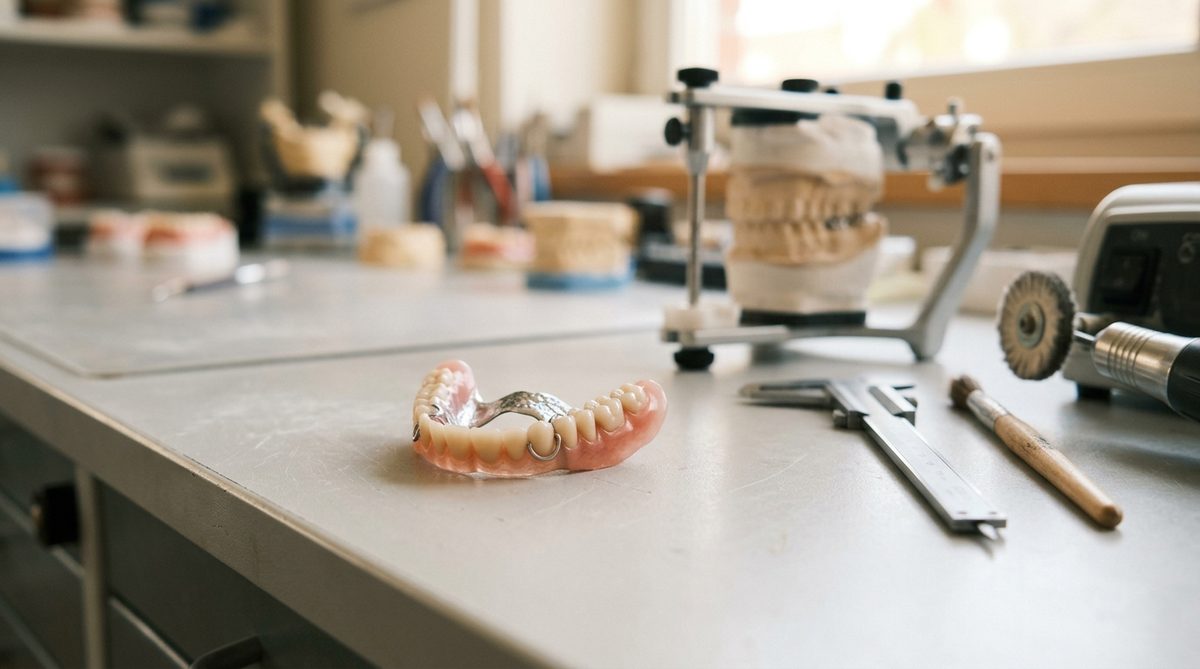
Summary
- The best partial dentures aren’t a brand. They’re a device that meets five measurable quality criteria: material spec, dimensional fit, finish and polish, occlusion calibration, and manufacturing transparency.
- ISO 20795-1:2013 is the international standard for denture base polymers. It sets exact limits on residual monomer, sorption, solubility, and flexural strength. A partial denture that misses these limits usually shows it within 6 to 12 months of wear.
- A quality partial denture should last 5 to 8 years. Acrylic at the lower end of the range, cast cobalt-chromium at the higher end. If yours fails inside a year, the issue is almost always manufacturing-side.
- Most “best partial dentures” articles compare three types and then punt the decision to your dentist. None of them tell you how to evaluate the actual fabrication.
- FDA-registered manufacturing is required for Class II removable partial dentures. Any seller should be able to name their registration and material specs on request.
- The honest carve-out: complex cases (severe periodontal disease, planned implant work, known monomer allergies) sometimes need a dentist-fitted route, not direct-from-lab. We say so when that applies.
What “best” actually means when you cut through the explainers
You’ve narrowed it down to a partial denture. Maybe you’re shopping for the first time. Maybe your old one is failing and you’re hoping the next one will be different.
Most articles you’ll find about the best partial dentures explain the three main types (cast metal, flexible, acrylic) and then send you to your dentist. That’s not wrong, but it skips the part you actually need: how to evaluate whether the partial denture you end up with is well made.
Brands don’t make partial dentures. Labs do. The brand on your packaging might be a dentist’s office, a direct-to-consumer e-commerce site, or a national denture chain, but the device itself was fabricated at a dental lab. What matters is whether that lab follows the manufacturing standards that determine whether the device works for five years or starts failing in twelve months.
So what are the best partial dentures when you cut through the explainers? Not a brand. A partial denture either meets five measurable criteria or it doesn’t, and the brand is downstream of that.
We’re a US dental lab. We’ve been fabricating partial dentures for 25+ years. The five criteria below are what we’d use if we were buying one ourselves.
The 5 criteria for evaluating partial dentures
What are the best partial dentures? Not a single product. There are five quality criteria a partial denture either meets or doesn’t, regardless of who’s selling it. Run any partial denture you’re considering, or one you already own, against this checklist.
Criterion 1: Material specification
What it is: ISO 20795-1:2013 sets measurable limits for denture base polymers. Sorption below 32 μg/mm³, solubility below 1.6 μg/mm³, residual monomer at or under 2.2% for heat-cured PMMA and 4.5% for self-cured, flexural strength at or above 65 MPa for most type ratings [1].
Why it matters: Residual monomer is the unpolymerized acrylic that leaches into your mouth from incompletely cured material. Sorption and solubility govern how much saliva the device absorbs. More absorption means a bacterial harbor, dimensional change, and odor over months.
How to evaluate: Ask the seller what material grade they use, and look for a specific answer rather than a generic one. A reputable seller can tell you whether their flexible partials use Valplast, Duraflex, or another nylon thermoplastic, whether their acrylic partials are heat-cured or self-cured, and where the framework metal comes from. If you don’t see the specifics on a product page, ask their support team directly. Labs that know their process can answer this in one email.
The three material categories you’ll encounter:
- Heat-cured PMMA acrylic. The gold standard for acrylic partials. Higher density, lower residual monomer, longer service life. Used for the base plate of most quality partial dentures.
- Flexible nylon thermoplastics (Valplast, Duraflex, TCS). Metal-free, hypoallergenic, gum-toned. No visible clasps. More comfortable for most wearers, slightly less durable than cast metal but lasts 5+ years with care.
- Cast cobalt-chromium framework. The strongest option. Thin profile (3 to 4 millimeters at the major connector), 10+ year lifespan, supports complex multi-tooth replacements. Visible metal clasps in most designs.
The catch: Self-cured (cold-cure) acrylic is the cheap, fast process. It’s legal and FDA-cleared, but it sits at the higher residual monomer ceiling and the device won’t last as long. Heat-cured PMMA is the higher-quality default and what reputable labs use for non-rush work.
Criterion 2: Dimensional fit and stability
What it is: How accurately the finished denture matches your intraoral anatomy, and how well it holds that geometry over time.
Why it matters: Heat-cured PMMA shrinks 0.2% to 0.6% by volume during polymerization [2]. A lab that doesn’t control packing pressure and cooling rate produces a denture that’s a few hundred microns off your impression. You feel it as rocking, sore spots, food trap, or progressive looseness within weeks.
How to evaluate before buying: Ask whether impressions are taken in office or with an at-home kit, and whether the lab does a try-in or bite verification step. A lab that uses an articulator-verified occlusion process is doing more than a lab that ships from a single impression.
How to evaluate after delivery: Does the denture seat passively without finger pressure? Does it rock when you push on one side? Are sore spots showing up in the same place repeatedly after the two-week break-in period?
Four concrete signs of a fit failure (not normal break-in):
- Persistent rocking when you push laterally on one side
- Sore spots that appear in the same location after the two-week adaptation period
- Food packing under the same area at every meal
- Audible clicking when you talk or eat
The catch: Even a perfectly fabricated denture needs a two to three week adaptation period. Normal break-in means gradual reduction in awareness with occasional sore spots that move. A poorly-fitting denture means persistent rocking, sore spots in the same spot, and food packing that doesn’t improve.
Criterion 3: Finish, polish, and porosity
What it is: The tissue-facing surface (the side against your gum) should be smooth, without pits, voids, or unfinished acrylic. The polished exterior should be uniformly glossy.
Why it matters: Surface porosity is where bacteria, Candida, and food debris colonize. ADA clinical assessment criteria for removable prosthodontics specifically evaluate finish, porosity, tissue surface, and polish quality as quality indicators [3]. A porous tissue surface is the most common cause of denture stomatitis, the mouth infection that doesn’t get much consumer-facing coverage.
How to evaluate: Hold the device under bright light. The tissue-facing surface should look like one continuous matte-smooth plane. Visible pinholes, rough patches, or unfinished trim are quality failures. The polished side should reflect light evenly.
The catch: Some new dentures have a faint chemical smell from residual monomer. That fades over one to two weeks of soaking and normal use. A persistent stale smell after a month is usually a porosity problem, not a hygiene problem.
Criterion 4: Occlusion calibration
What it is: Bilateral balanced contact between your partial denture’s teeth and your opposing arch, with proper vertical dimension and no premature contact points.
Why it matters: A partial with one premature contact loads that tooth disproportionately. You’ll feel it as tooth pain, accelerated wear on the natural opposing tooth, headaches from clenching to avoid the contact, and (over years) bone loss around the loaded abutment teeth.
How to evaluate: Bite down evenly. The contact should feel even left to right and front to back. Articulating paper (the colored thin tape your dentist uses) leaves even marks across all opposing teeth, not one dark spot. If you find yourself shifting your jaw to avoid a high spot, the occlusion needs adjustment.
The catch: A small bite-off is normal on a brand-new partial. A one or two visit adjustment to refine occlusal contacts is part of any quality fitting protocol. It’s not a quality failure. What is a quality failure is a denture that arrives without articulator-verified occlusion in the first place.
Criterion 5: Manufacturing transparency
What it is: Can the seller name where the device is made, what materials are used, what FDA registration applies, and what certifications the lab holds?
Why it matters: Partial dentures are FDA Class II medical devices, Product Code EBO (removable partial dentures) [4]. Any US-shipped device must come from an FDA-registered facility. NADL (National Association of Dental Laboratories) certification and DAMAS (Dental Appliance Manufacturers Audit Scheme) are voluntary but indicate documented quality management systems [5]. A lab unwilling to disclose any of this is a red flag.
How to evaluate: Look for FDA registration on the lab’s website or packaging. Ask whether the lab is NADL-certified or DAMAS-audited. Ask where the device is physically fabricated. “Made in USA” is a meaningful claim because offshore labs often lack FDA registration and aren’t subject to the same audit requirements.
The catch: Not every reputable lab is NADL or DAMAS certified. The audit and certification cost is real, and skipping the voluntary credentials doesn’t mean a lab is bad. But FDA registration is non-optional, and any US-selling lab that won’t disclose theirs is operating outside the regulation.
Three tiers of partial dentures, side by side
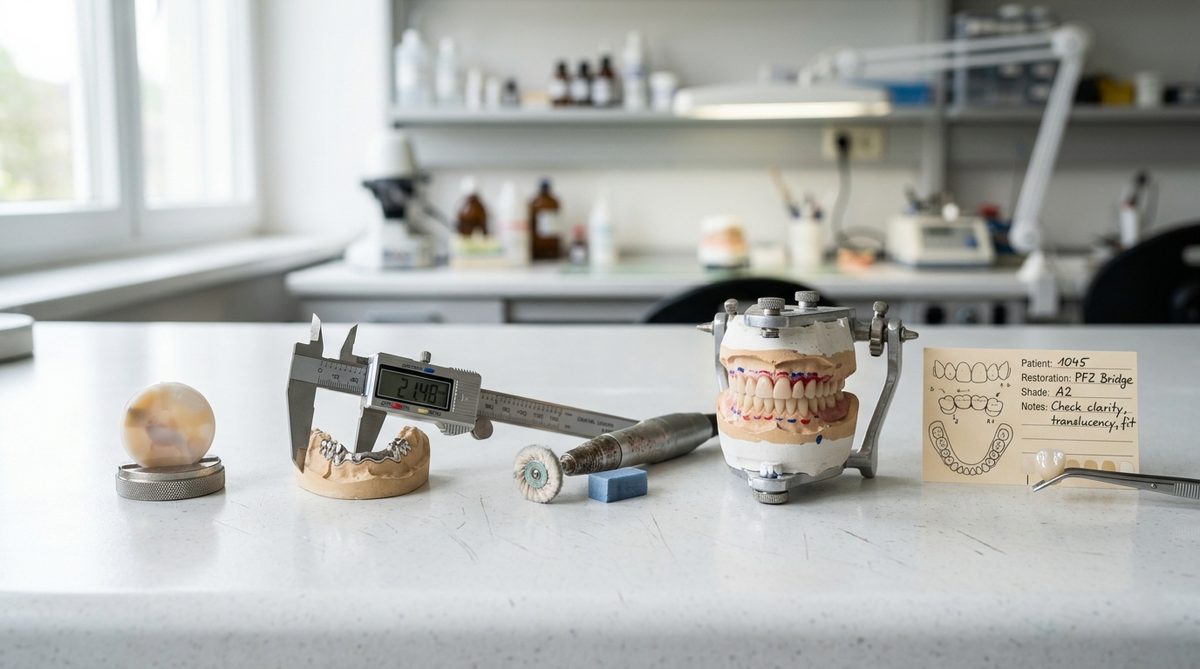
If you want to and compare across material categories, the product category page is the cleanest off-ramp. The table below is the tier-level view.
The lab-side answer most “best partial dentures” articles don’t give you
Here’s what most explainers won’t say out loud.
The same lab often fabricates partial dentures for multiple sales channels. A dentist’s office, a DTC site, a small denture chain. Same equipment. Same technicians. Same FDA-registered facility. The device that ships to each channel can be materially identical.
The cost difference between channels isn’t material cost or manufacturing process. It’s overhead. Office rent, chair time, practice management, the dentist’s time during the fitting appointment. Those are all real costs that real patients sometimes need. A complex prosthodontic case with multiple abutment teeth, severe periodontal disease, or planned implant integration is worth paying for in-office, because the dentist’s diagnostic and adjustment time is the value.
For a straightforward partial denture replacement case (stable mouth, clear impression, no complicating factors), the device-only cost from a lab-direct seller buys you the same fabrication without the office overhead. That’s the underlying logic of the DTC custom tier.
This isn’t an attack on dental offices. It’s the reason the DTC tier exists, and why understanding the five criteria above lets you evaluate quality independent of where you buy.
What to do next, based on your situation
Five common situations. Pick the one that fits you.
- You’re shopping for a partial denture for the first time and don’t have one to compare. Run the five criteria as a buyer’s checklist before you commit to any seller. Ask the seller to name material spec, fabrication process, FDA registration, and impression method. If they can’t answer specifically, move on. Don’t fall for “FDA-approved acrylic” with no further detail.
- You have a partial denture now and it’s slipping, rocking, or developing sore spots after the break-in period. This is usually a dimensional fit issue (Criterion 2). Reseating, relining, or remaking from a new impression is the standard fix. If your current denture is under 12 months old, the lab should remake it under their warranty.
- Your partial denture cracked, warped, or developed surface roughness within the first year. This is a material spec issue (Criterion 1) or porosity issue (Criterion 3). It usually means the device wasn’t fabricated to ISO 20795-1 limits. Replacement, not repair, is the right answer.
- You’re considering a $50 to $200 boil-and-bite or no-impression online partial. It’s fine for temporary use. It will not meet any of the five criteria. Don’t expect more than 6 to 18 months of wear. If you need long-term function, the DTC custom tier is where the value lives.
- You have a complex case (multiple missing teeth across both arches, severe periodontal disease, planned implant work, or a known monomer allergy). The DTC custom tier may not be your right answer. A prosthodontist or implant-trained dentist who can plan the full restoration belongs in the loop. Tell us if this is you and we’ll often recommend you don’t order from us.
Still mapping your situation to one of these five?
If your case sits between the scenarios above, or if you have a partial denture now that you’re not sure passes the five criteria, our team can run through the checklist with you on a call. We’ve spent 25 years auditing partial dentures, including ones we didn’t make. Sometimes the answer is “yes, get a new one from us.” Sometimes it’s “no, take this back to whoever fabricated it.” Reach us at 1-888-591-2220 or via the .
FAQ
- How long should a quality partial denture last?
A well-made partial denture that meets ISO 20795-1 material specs typically lasts 5 to 8 years before relining or replacement is needed. Cast cobalt-chromium frameworks can last 10+ years. Acrylic-only partials sit at the lower end. If yours fails before 12 months, the device almost certainly didn’t meet the manufacturing spec.
- How do I know if my partial denture is poorly made?
Run it against the five criteria above. Concrete signs of a quality failure: persistent sore spots in the same place after the two-week break-in, visible pinholes or rough patches on the tissue surface, a persistent stale smell that doesn’t fade with cleaning, audible clicking from poor occlusion, and visible warping or color shift within the first year.
- Are online partial dentures lower quality than dentist-made ones?
Not inherently. Both come from labs. The question is which lab and which process. A DTC custom partial denture from a reputable US dental lab using professional-grade, FDA-approved materials is materially identical to a dentist-fitted partial from the same kind of lab. The cost gap is overhead, not quality. To verify any online seller, ask them five questions: what materials they use, where their lab is located, what their warranty covers, how they handle fit issues, and how long they’ve been making partial dentures. Sellers who know their process answer those quickly.
- What materials are used in the best partial dentures?
Cast cobalt-chromium framework is longest-lasting and thinnest, ideal for complex multi-tooth cases. Heat-cured PMMA acrylic is the gold standard for acrylic partials and must meet ISO 20795-1 thresholds. Nylon-based thermoplastics like Valplast and Duraflex are flexible, metal-free, and hypoallergenic. The choice between them depends on case complexity, aesthetic priority, and budget. There’s no universally best material; there’s a best-fit material for your situation.
- Can I evaluate a partial denture before I buy it?
You can evaluate the seller’s process: ask about materials, fabrication location, impression method, warranty terms, and how they handle fit issues. You can’t evaluate the physical device until it arrives. Reputable sellers stand behind their warranty if anything’s off on delivery. Our partial dentures come with a 60-day warranty on all custom-made products. If the device doesn’t fit or meet expectations when it arrives, contact us and we’ll work with you on it.
- What’s the most comfortable type of partial denture?
Flexible partial dentures (Valplast, Duraflex, and similar nylon-based thermoplastics) are typically rated most comfortable by wearers because they have no metal clasps and adapt to mouth contours. Cast metal partials are thinner and stronger but feel more rigid. Acrylic-only partials sit in between. Comfort also depends heavily on Criterion 2 (fit) and Criterion 4 (occlusion), so a well-made acrylic can be more comfortable than a poorly-made flexible.
25+ years as a . Professional-grade FDA-approved materials, non-allergenic and BPA-free. Custom-made at our dental lab. 1,000+ verified reviews. 60-day warranty on all custom-made products.
If you’re ready for a partial denture that meets all five criteria
Order online. Your at-home impression kit ships in days with custom-fit trays, pre-measured putty, step-by-step instructions, and a prepaid USPS return label. Submit a photo of your impressions for free review before you send them back. The custom partial denture is then crafted at our dental lab over 3 to 4 weeks. It ships with a 60-day warranty on all custom-made products. If anything’s off when it arrives, contact us and we’ll make it right.
Real materials. Real fit. Real lab.
Sources
[1] ISO 20795-1:2013. Dentistry, Base polymers, Part 1: Denture base polymers. International standard specifying mechanical, biological, and processing requirements for PMMA denture base materials.
[2] Polymeric Denture Base Materials: A Review. Polymers (Basel), 2023 (PMC). Covers volumetric shrinkage, sorption, and processing variables for PMMA denture bases.
[3] American Dental Association. Clinical assessment criteria for removable prosthodontics. Covers finish, porosity, tissue surface, polish, and occlusal quality as quality indicators.
[4] FDA Product Classification Database. Product Code EBO: Denture, Partial, Removable. Class II medical device.
[5] National Association of Dental Laboratories. Certified Dental Laboratory (CDL) program. Voluntary lab certification covering quality systems, materials traceability, and regulatory compliance.